Desktop 3D printing
Each flexure is printed from the same CAD model with a fixed set of printing parameters, so the kinematics stay consistent across independently fabricated units.
Tactile data and policies that transfer across sensor instances.
Project video: portable collection, then the same policy on independently fabricated fingertips.
Scaling tactile robot learning is limited less by a single sensor reading than by whether that reading, and the policy trained on it, still mean the same thing on the next device. PrintTac is a reproducible tactile fingertip for that setting. A monolithic 3D-printed flexure and an off-the-shelf magnetometer array encode contact as a compact magnetic signal, so force models and manipulation policies transfer to independently fabricated instances without per-device recalibration. On an untethered UMI, the phone logs touch, vision, and ARKit pose together, which is what makes collecting the next demonstration as reusable as the last. On insertion, grasping, and surface wiping, policies conditioned on PrintTac outperform vision-only policies trained on the same demonstrations, including when online vision is removed and only the initial frame remains.
A portable UMI gripper with PrintTac fingers collects demonstrations; independently fabricated fingertips then deploy the same policy on the robot.
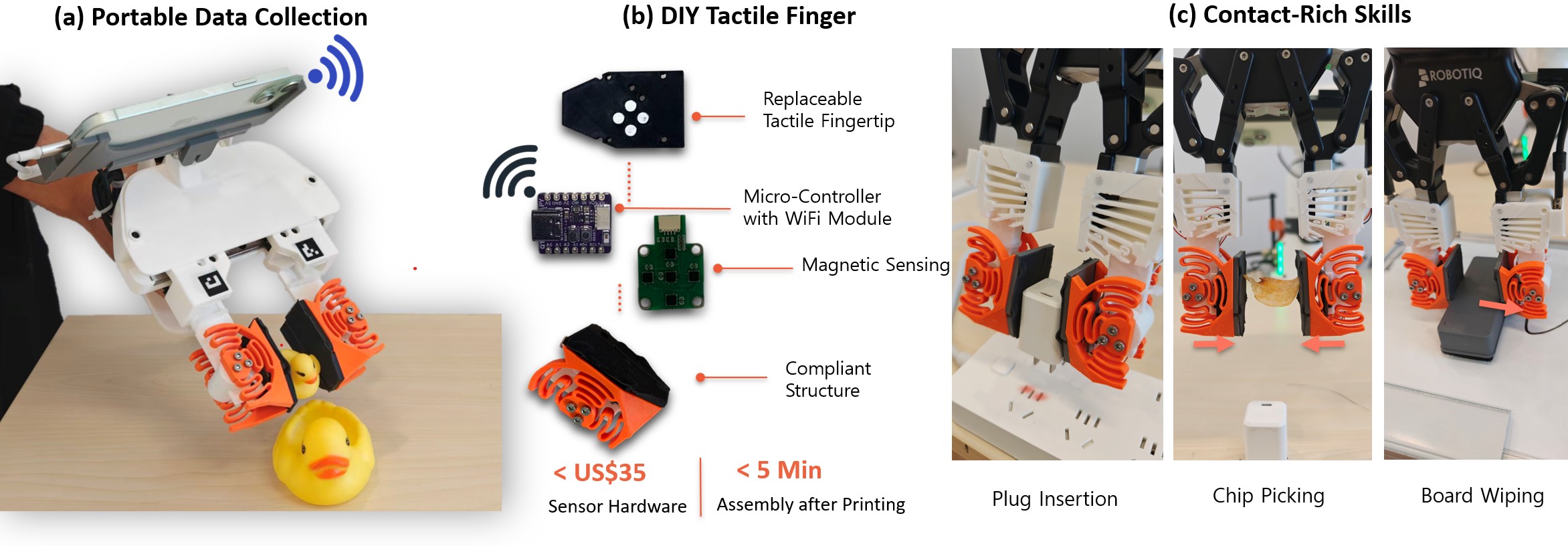
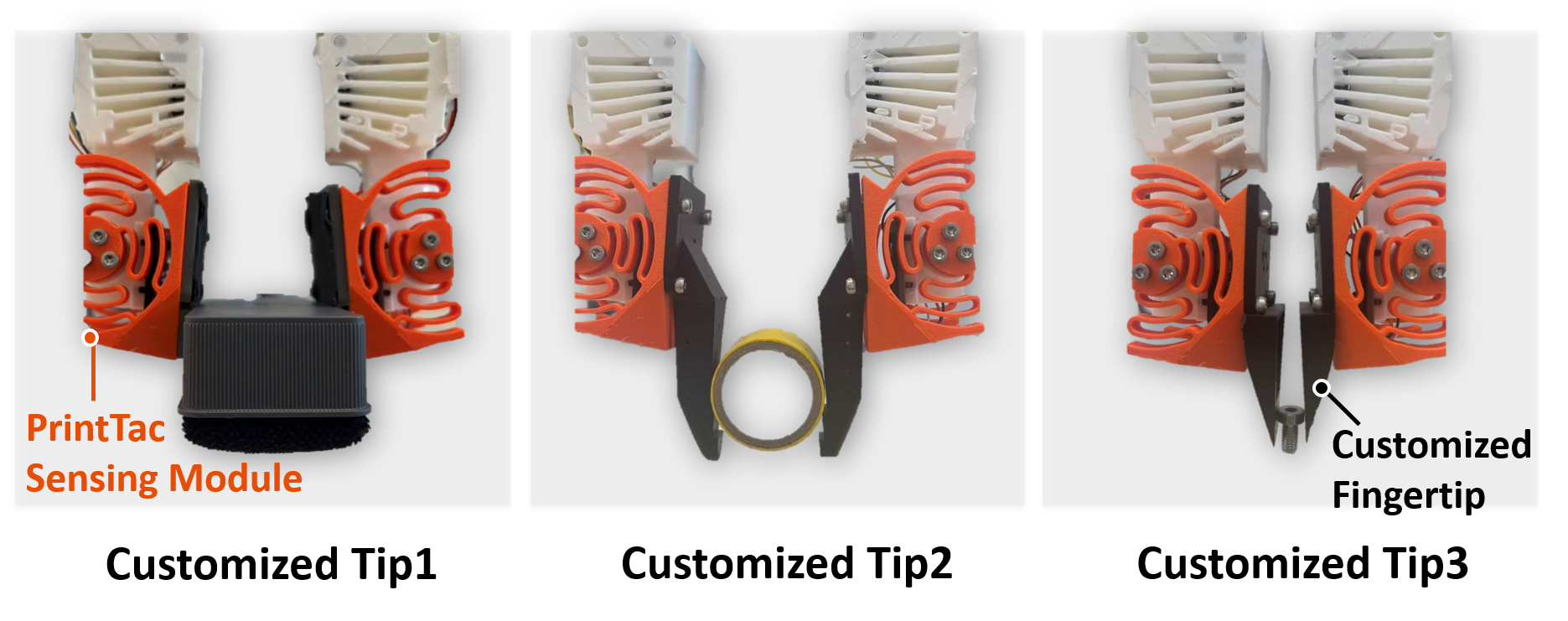
PrintTac is built around mechanical determinism: a PETG flexure printed from a fixed CAD model, an off-the-shelf magnetometer array, and a contact tip that can be swapped in under one minute.
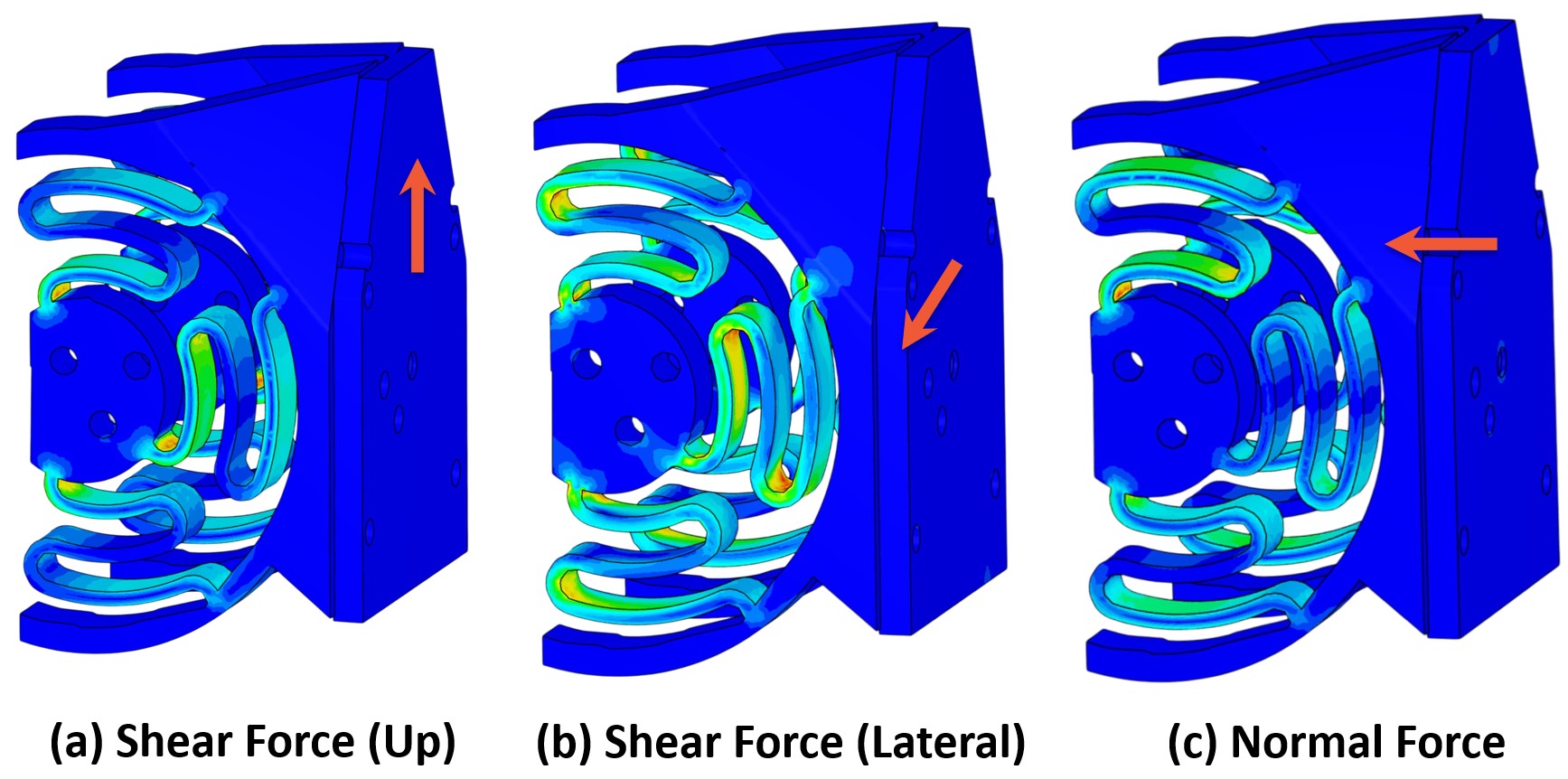
Optical fingertips turn touch into another image to encode, and cast skins change from mix to mix, so a dataset or policy rarely survives a sensor swap. A monolithic PETG flexure keeps the contact-to-signal mapping stable enough to reuse.
Each flexure is printed from the same CAD model with a fixed set of printing parameters, so the kinematics stay consistent across independently fabricated units.
Five three-axis magnetometers, magnets on the contact plate, and a wireless microcontroller. The same printed design is what lets a policy trained on one set of fingers run on another.
All visual, tactile, and kinematic streams are ingested on the handheld iPhone. There is no tether to a host PC during demonstration.
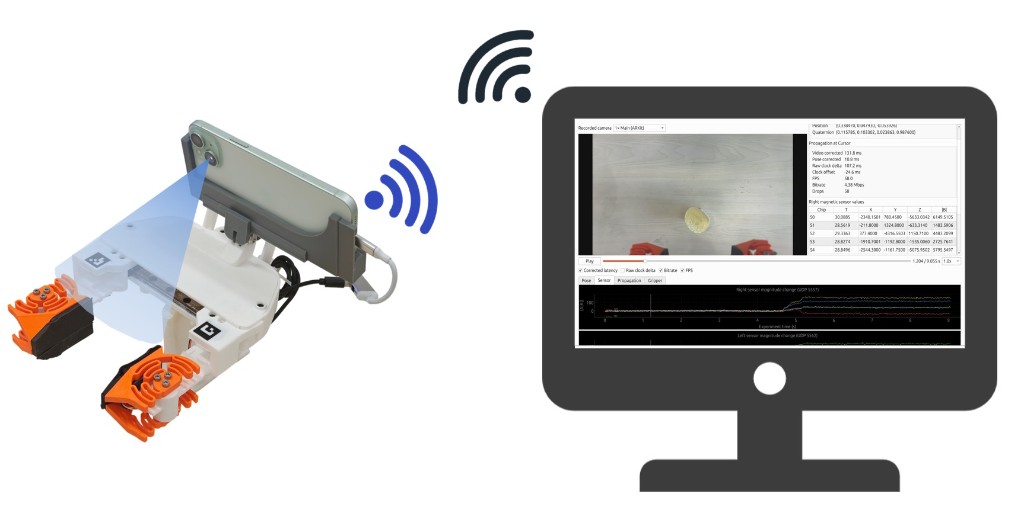
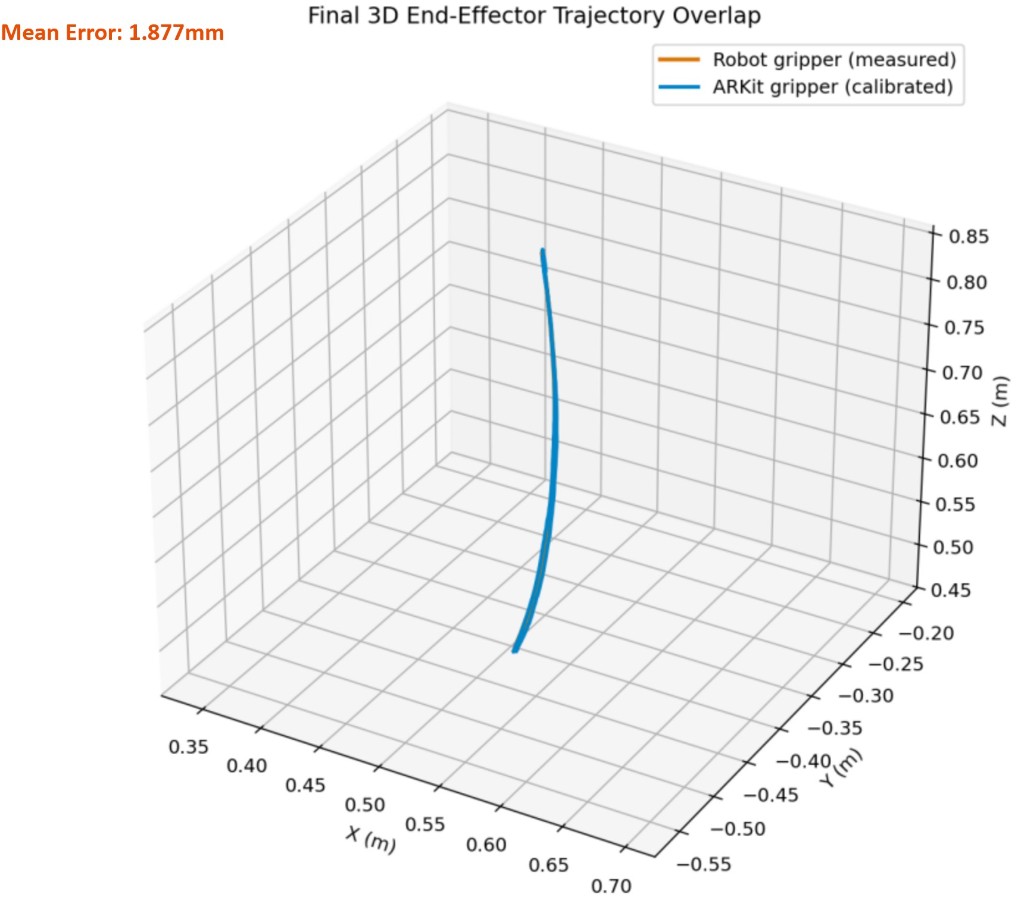
UMI demonstration with wrist RGB, PrintTac, and ARKit pose recorded onboard the iPhone.
The same untethered pipeline collects visuo-tactile demonstrations for tight-tolerance insertion.
Contact-rich wiping demonstrations without a host PC tether during collection.
A conditional diffusion policy consumes wrist RGB, raw PrintTac measurements, and proprioception. Tactile readings are normalized and concatenated directly, without a ViT or CNN tactile encoder.
An MLP trained on one fingertip transfers to an independently fabricated instance without recalibration, fine-tuning, or baseline offset adjustment.
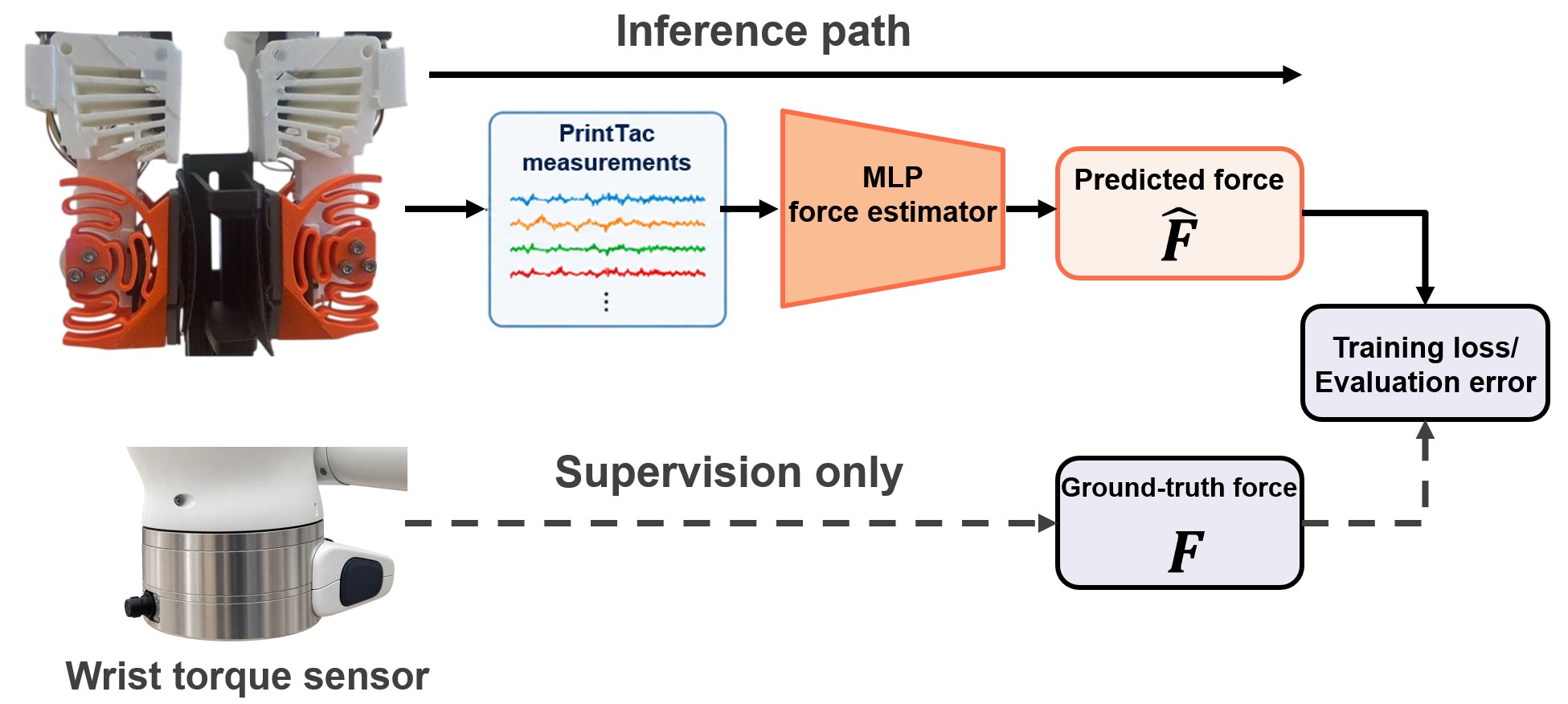
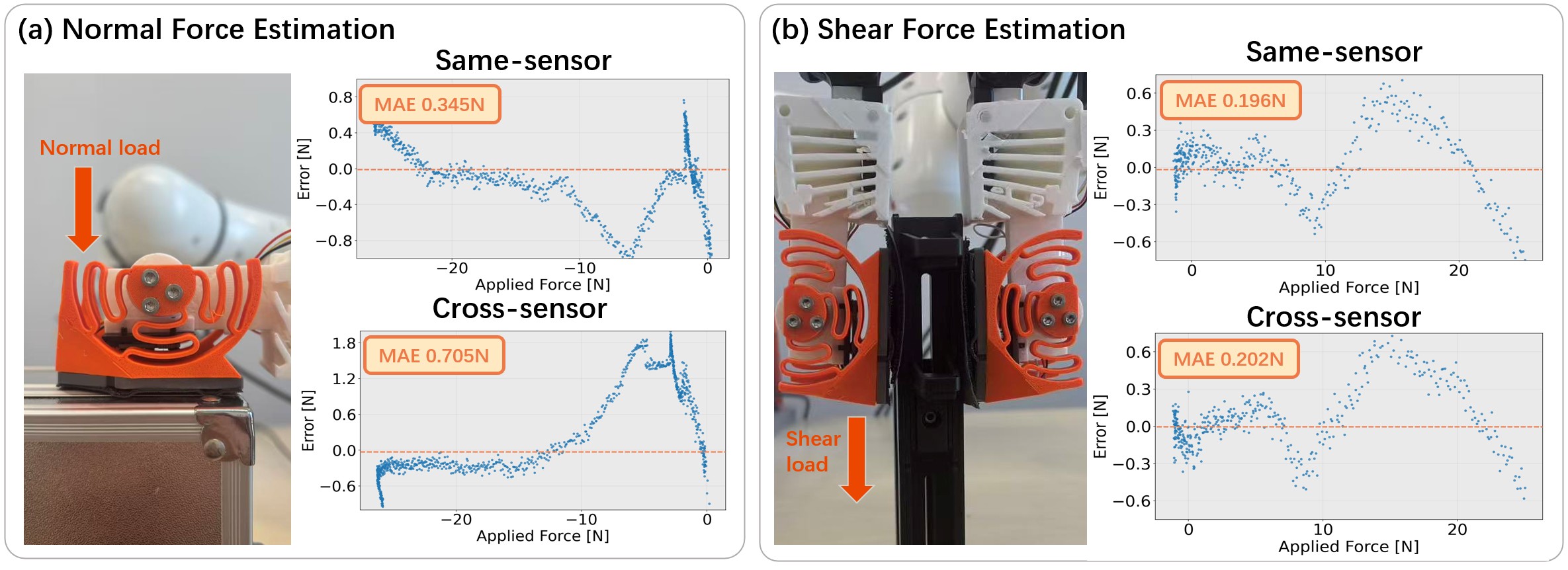
Policies are trained on demonstrations from sensor instances Sdemo and rolled out on independently fabricated Seval without retraining. Each comparison shows PrintTac (left) versus vision-only (right).
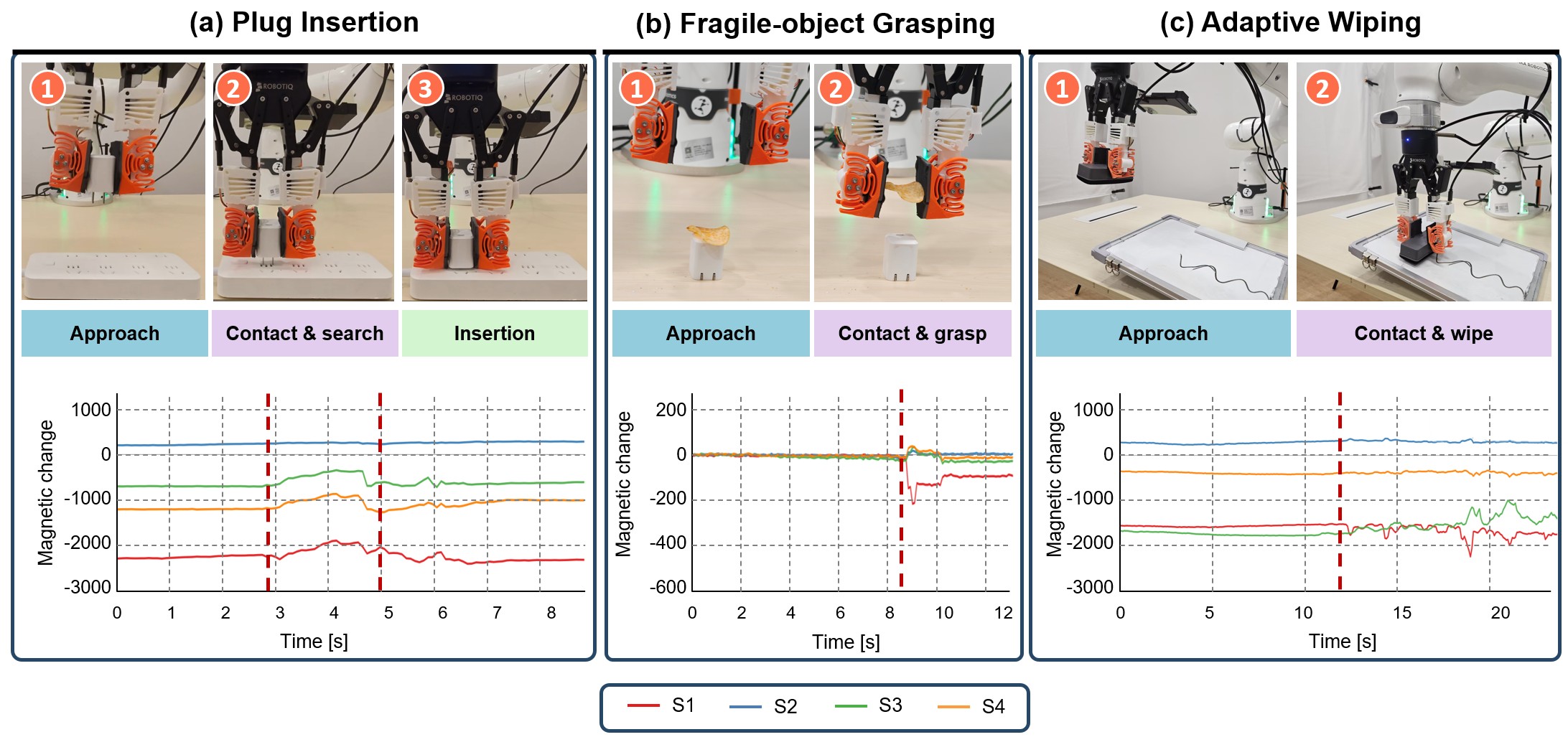
63 demonstrations. Tactile contact onset stops finger closure before the chip fractures. Vision-only often drops or crushes it. 20% → 100%.
65 demonstrations. Touch detects casing contact and snap-through; vision-only can jam against the housing. 40% → 90%.
68 demonstrations, evaluated on boards tilted up to 15°. Tactile preload tracks the incline; vision-only loses contact. 30% → 90%.
Both policies receive only the initial image o0. Only the PrintTac policy gets closed-loop touch. 0% → 90%.
Table I. Ten matched trials per task. Timeouts over 45 seconds count as failures.
| Task | Vision only | Vision + PrintTac |
|---|---|---|
| Plug insertion | 40% (4/10) | 90% (9/10) |
| Chip picking | 20% (2/10) | 100% (10/10) |
| Whiteboard wiping | 30% (3/10) | 90% (9/10) |
| Tactile-only wiping | 0% (0/10) | 90% (9/10) |
Insertion succeeds when more than 80% of the plug length enters the socket. Chip picking succeeds when the chip is grasped and lifted. Wiping succeeds when more than 90% of visible markings are removed.
If you find this work useful, please cite:
@inproceedings{printtac2026,
title = {PrintTac: Reproducible Tactile Fingertips for Scalable Robot Learning},
author = {Haoran Qin and Yunzhi Wu and Minghui Lin and Shu Wang and Anpei Chen},
year = {2026},
note = {Under review}
}